Have you ever wondered what it feels like to touch a story carved in stone, or to stand in a place where history isn’t just read, but felt? India, a crucible of ancient civilizations, offers this profound experience through its staggering collection of UNESCO World Heritage Sites. With 42 designated sites, the country is a living museum, a testament to millennia of architectural genius, spiritual devotion, and cultural fusion.
This isn’t just about visiting ruins; it’s about uncovering the layers of meaning, much like an archaeologist brushing dust from a hidden fresco. It’s about understanding the ambition that carved mountains into monasteries and the love that raised a monument of marble to the sky. As one archaeologist in the field once said, “These sites are living testaments. They hold secrets beyond what the eye can see.” Prepare to journey through India’s most powerful historical landscapes, where every stone tells a story.
ROCK-CUT MARVELS
The Dawn of Devotion: Sanctuaries Sculpted from Earth
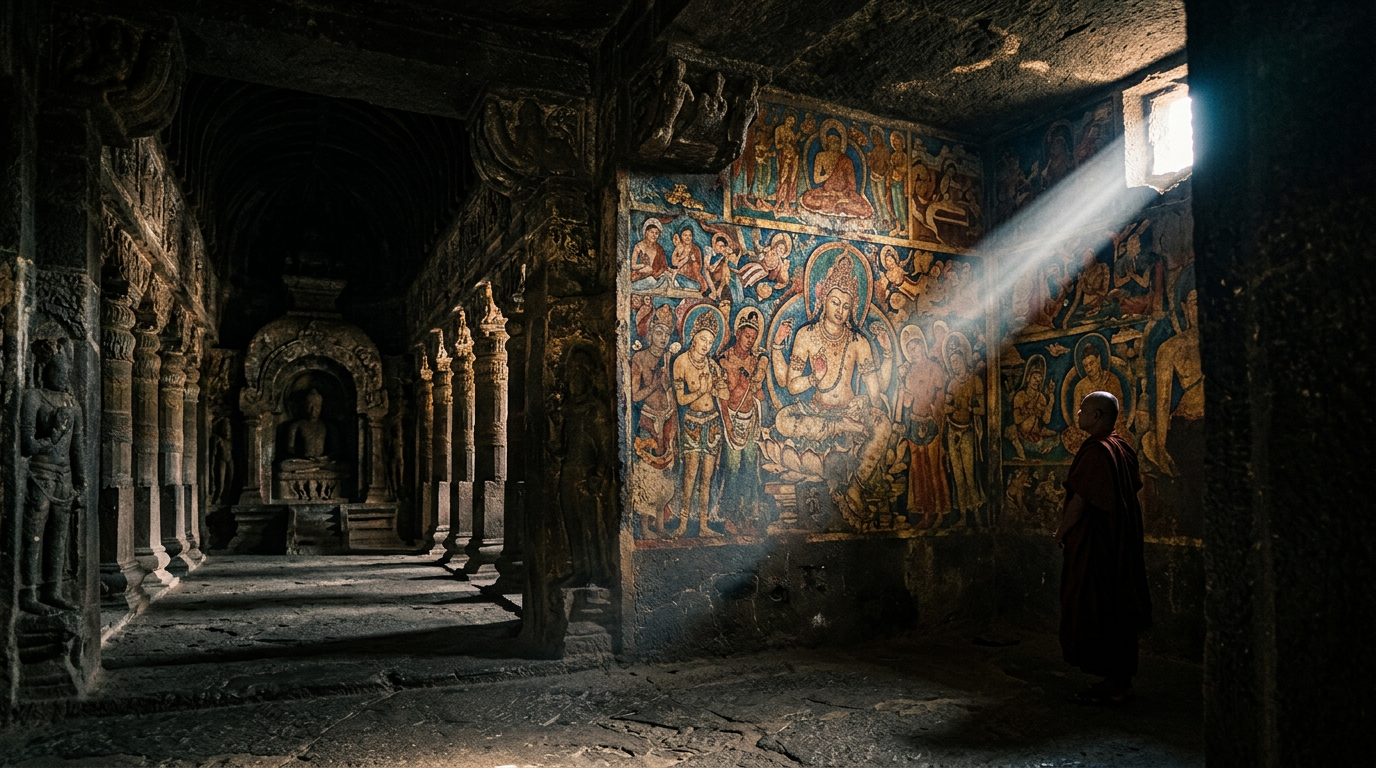
Our journey begins in the volcanic basalt cliffs of Maharashtra, where ancient artisans didn’t build structures—they revealed them. The Ajanta and Ellora Caves are not just buildings; they are entire worlds hollowed out of living rock, a powerful testament to faith and superhuman effort.
Ajanta Caves: A Canvas of Ancient Life
Secluded in a horseshoe-shaped gorge, the 30 rock-cut caves of Ajanta are a treasure trove of Buddhist religious art. Created between the 2nd century BCE and 6th century CE, their isolation helped preserve some of the finest masterpieces of Indian painting. These are not mere decorations; the frescoes depict the Jataka tales—stories of the Buddha’s previous lives.
What makes them so extraordinary is their naturalism and emotional depth. The artists used mineral and vegetable pigments to create a vibrant palette that brings these ancient narratives to life with astonishing clarity. When visiting, notice the calligraphic lines and the expressive faces, which convey a range of emotions from serenity to sorrow.
Ellora Caves: A Symphony of Faiths
A short journey from Ajanta lies Ellora, a site that embodies India’s long history of religious tolerance. Here, 34 caves were carved side-by-side, representing three major religions:
- Buddhist Caves (1-12): The earliest structures, featuring monasteries and shrines.
- Hindu Caves (13-29): The centerpiece is the Kailasa Temple (Cave 16).
- Jain Caves (30-34): Smaller in scale but featuring highly detailed carvings.
The Kailasa Temple is the undisputed masterpiece. It is the world’s largest single monolithic excavation, a chariot-shaped temple carved downwards from a single piece of cliff face. It’s estimated that workers excavated over 200,000 tonnes of rock to create it—a feat of engineering that boggles the modern mind.
IMPERIAL GRANDEUR
Mughal Splendor: Architecture as Poetry
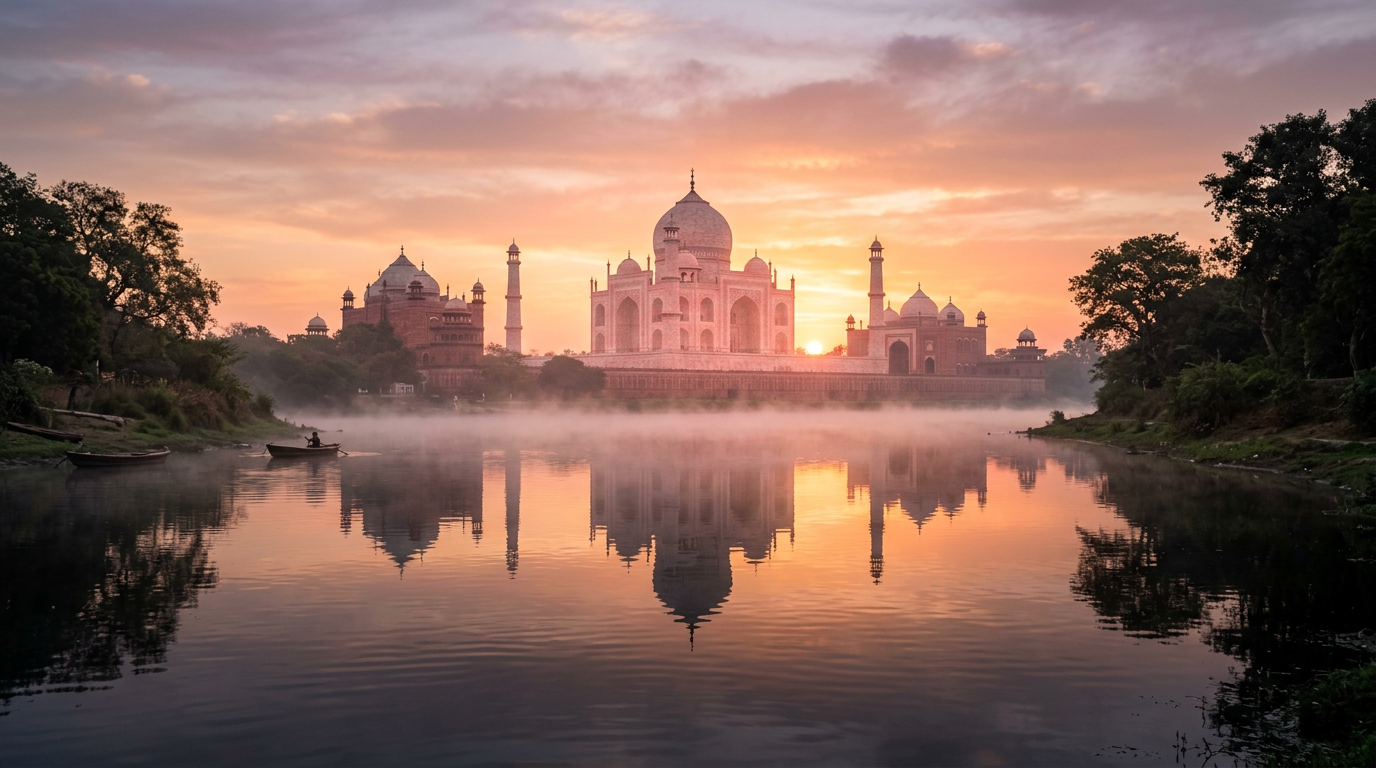
From the raw power of rock-cut caves, we move to the refined elegance of the Mughal Empire. This era (16th to 19th centuries) gifted the world some of its most iconic architectural wonders, characterized by symmetry, intricate detail, and a harmonious blend of Persian, Indian, and Islamic styles.
The Taj Mahal: A Teardrop on the Cheek of Time
No exploration of India’s UNESCO sites is complete without the Taj Mahal. Commissioned in 1632 by Emperor Shah Jahan for his beloved wife Mumtaz Mahal, it is more than a tomb; it is an immortal expression of love and grief. Its perfect symmetry, the gleaming white marble that changes color with the light, and the exquisite pietra dura inlay work make it a global icon.
The entire complex is a masterpiece of design, from the four minarets that lean slightly outwards (to protect the main dome in an earthquake) to the Charbagh garden representing the Islamic vision of paradise.
Humayun’s Tomb: The Precursor to Perfection
Located in Delhi, Humayun’s Tomb is often called the precursor to the Taj Mahal. Built in 1570, it was the first garden-tomb on the Indian subcontinent and established a new standard for Mughal architecture. Its use of red sandstone contrasted with white marble, the double dome, and the formal garden layout were revolutionary concepts that directly inspired the Taj.
Fatehpur Sikri: The Ghost City
For a brief period, Emperor Akbar made Fatehpur Sikri his capital. This fortified city is a stunning example of Mughal urban planning, blending different architectural traditions. However, it was abandoned shortly after its completion due to a lack of water, leaving behind a perfectly preserved “ghost city” that offers a unique glimpse into the life of the Mughal court.
LIVING TEMPLES & LOST CITIES
The Enduring Legacy of Southern Dynasties
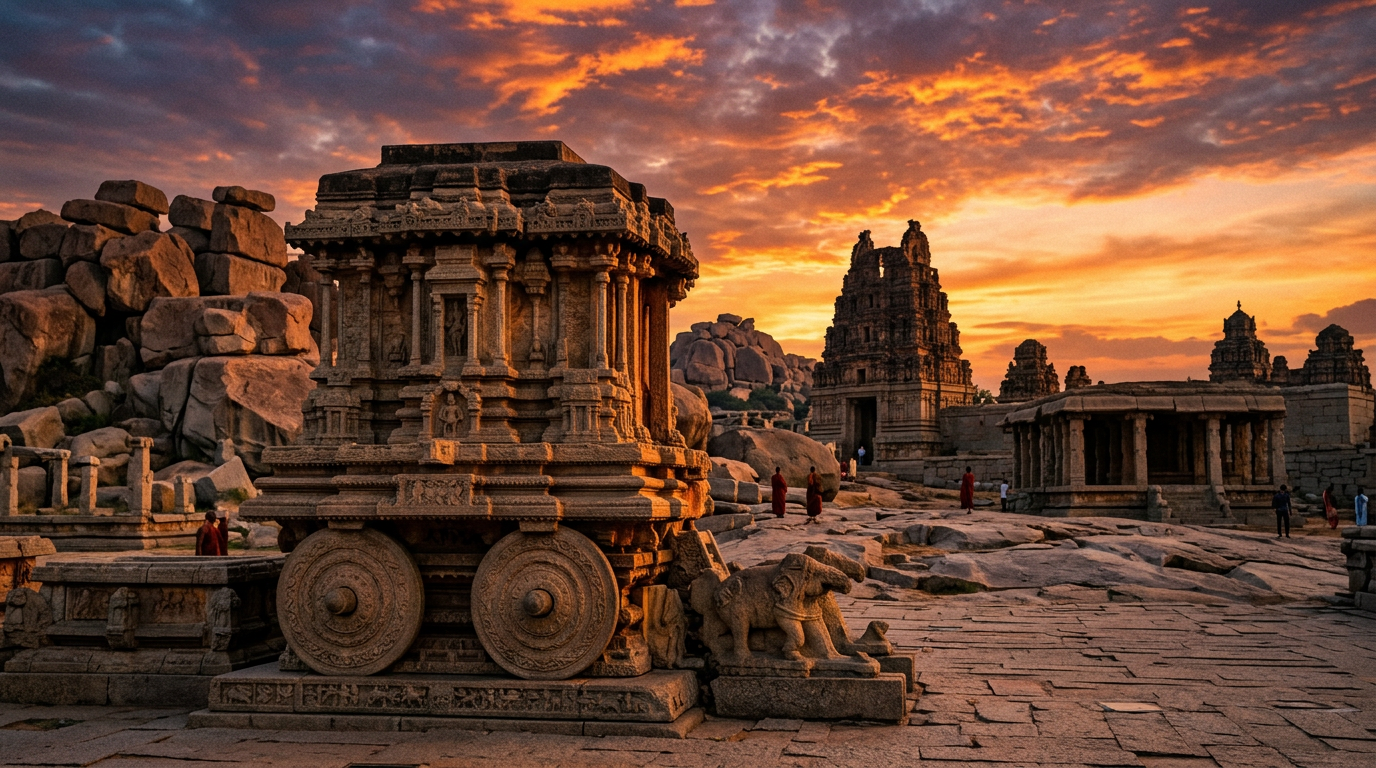
In the south, great empires like the Cholas and the Vijayanagara left behind sprawling temple complexes and cities that were the epicenters of religion, art, and commerce. These are not just monuments; they are “living temples” where worship continues to this day.
Hampi: The World of Boulders and Ruins
The Group of Monuments at Hampi is set in a surreal landscape of giant granite boulders. This was the last capital of the great Vijayanagara Empire, one of the most powerful in Indian history. The ruins are spread over a vast area and include:
- Virupaksha Temple: A functioning temple and the oldest shrine in the area.
- Vittala Temple Complex: Home to the famous stone chariot and “musical pillars.”
- Royal Centre: Containing the Queen’s Bath, Elephant Stables, and Lotus Mahal.
Great Living Chola Temples
The Chola dynasty, which ruled for over 1,500 years, perfected Dravidian temple architecture. This UNESCO site comprises three magnificent temples in Tamil Nadu: the Brihadisvara Temple at Thanjavur, the Temple of Gangaikonda Cholapuram, and the Airavatesvara Temple at Darasuram. They are renowned for their towering vimanas (temple towers), exquisite bronze sculptures, and detailed stone carvings.
SCIENTIFIC & CULTURAL INGENUITY
Where Science, Art, and Water Converge
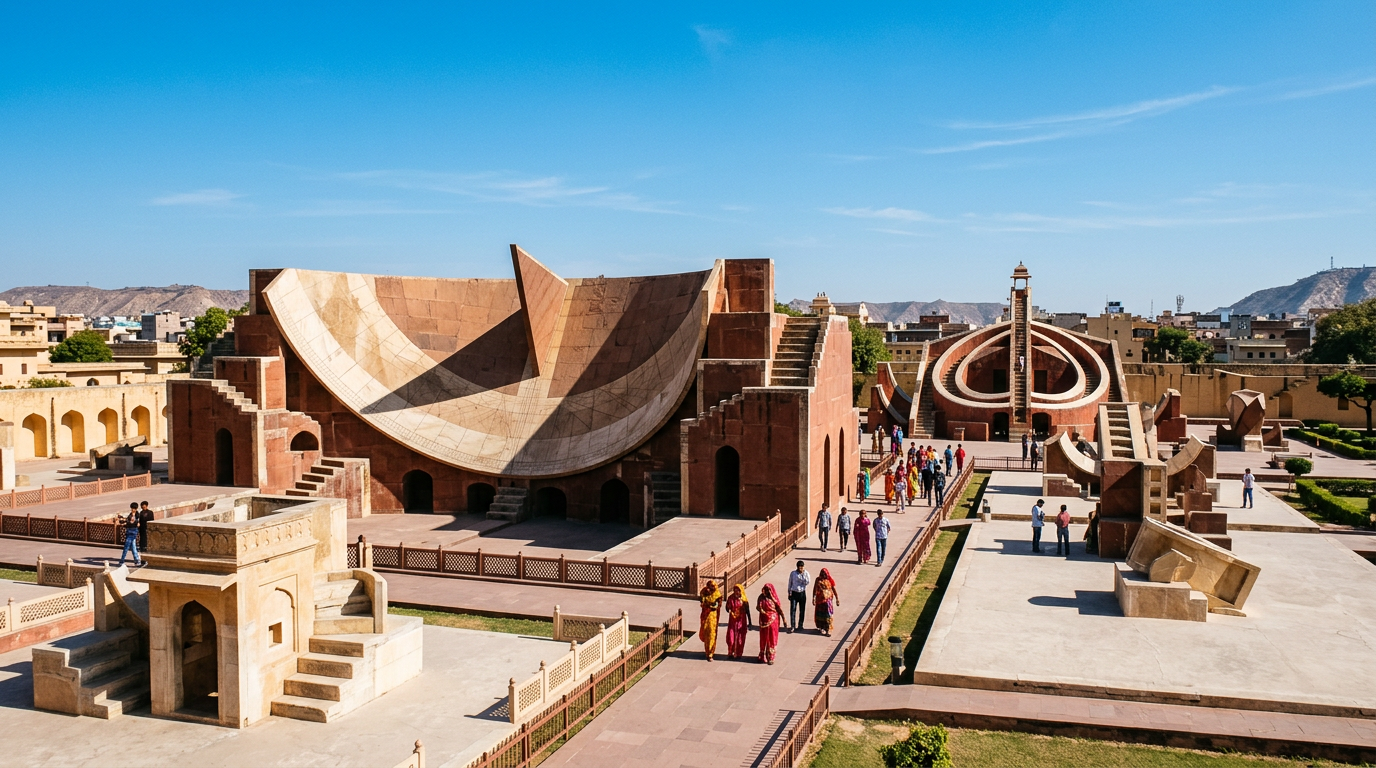
India’s heritage is not limited to temples and tombs. Several sites celebrate the country’s remarkable achievements in science and public works, demonstrating a deep understanding of astronomy, engineering, and resource management.
Jantar Mantar, Jaipur: A Cosmic Observatory
At first glance, the Jantar Mantar in Jaipur might look like a collection of giant, abstract sculptures. In reality, it is a sophisticated astronomical observatory, built in the early 18th century by Maharaja Sawai Jai Singh II. It houses the world’s largest stone sundial, the Samrat Yantra, which can tell the time with an accuracy of about two seconds. The instruments were designed to track celestial movements, predict eclipses, and determine the positions of stars—all without a telescope.
Rani ki Vav: The Inverted Temple
In Gujarat stands one of India’s most unusual UNESCO sites—a stepwell. Rani ki Vav (Queen’s Stepwell) was built in the 11th century as a memorial to a king, designed as an inverted temple that descends seven levels deep into the earth. Its walls are adorned with over 500 principal sculptures and more than a thousand minor ones, depicting mythological and religious imagery. It is a masterpiece of subterranean architecture, combining function (water storage) with profound artistic beauty.
Mountain Railways of India
Three mountain railways—the Darjeeling Himalayan Railway, the Nilgiri Mountain Railway, and the Kalka-Shimla Railway—are collectively recognized as UNESCO sites. These engineering marvels, built during the British colonial era, represent outstanding examples of innovative solutions for establishing effective rail links through rugged mountain terrain. The Darjeeling “Toy Train,” chugging through tea plantations at over 7,000 feet, remains one of India’s most iconic travel experiences.
India’s UNESCO Heritage at a Glance
| Category | Notable Sites | Era / Period |
|---|---|---|
| Rock-Cut | Ajanta, Ellora, Elephanta | 2nd century BCE – 10th century CE |
| Mughal | Taj Mahal, Humayun’s Tomb, Fatehpur Sikri, Red Fort | 16th – 19th century |
| Dravidian | Chola Temples, Mahabalipuram, Hampi | 7th – 16th century |
| Scientific | Jantar Mantar, Rani ki Vav, Mountain Railways | 11th – 19th century |
| Natural | Western Ghats, Sundarbans, Kaziranga, Nanda Devi | Timeless ecosystems |
To walk through India’s UNESCO sites is to walk through the entire arc of human civilization—from the first marks scratched on cave walls to the precision instruments that mapped the cosmos. Each site is a chapter in a story that is still being written, a reminder that the genius of the past is not just preserved in stone, but lives on in the culture, the art, and the spirit of the people who continue to call these places sacred.
Published by Adiyogi Arts. Explore more at adiyogiarts.com/blog.
Written by

Aditya Gupta
Responses (0)