Can a machine ever truly understand a prayer? Can lines of code capture the soul of an art form born from ritual, whispered from mother to daughter through generations? For the ancient tradition of Madhubani painting, this wasn’t a philosophical debate—it was a question of survival. This vibrant, intricate art from the Mithila region of India, with its roots in the epic Ramayana, was fading, its colors dimming against the glare of modernity.
But in an extraordinary fusion of past and future, a powerful new ally has emerged. The groundbreaking field of Madhubani Painting AI is not just about digitizing patterns; it’s about creating a bridge between the ancestral knowledge of village artisans and the boundless potential of machine learning. This is the story of how algorithms are learning to speak a language of gods and goddesses, preserving a priceless cultural legacy and igniting a digital renaissance.
CULTURAL HERITAGE
The Soul of Mithila: What is Madhubani Painting?
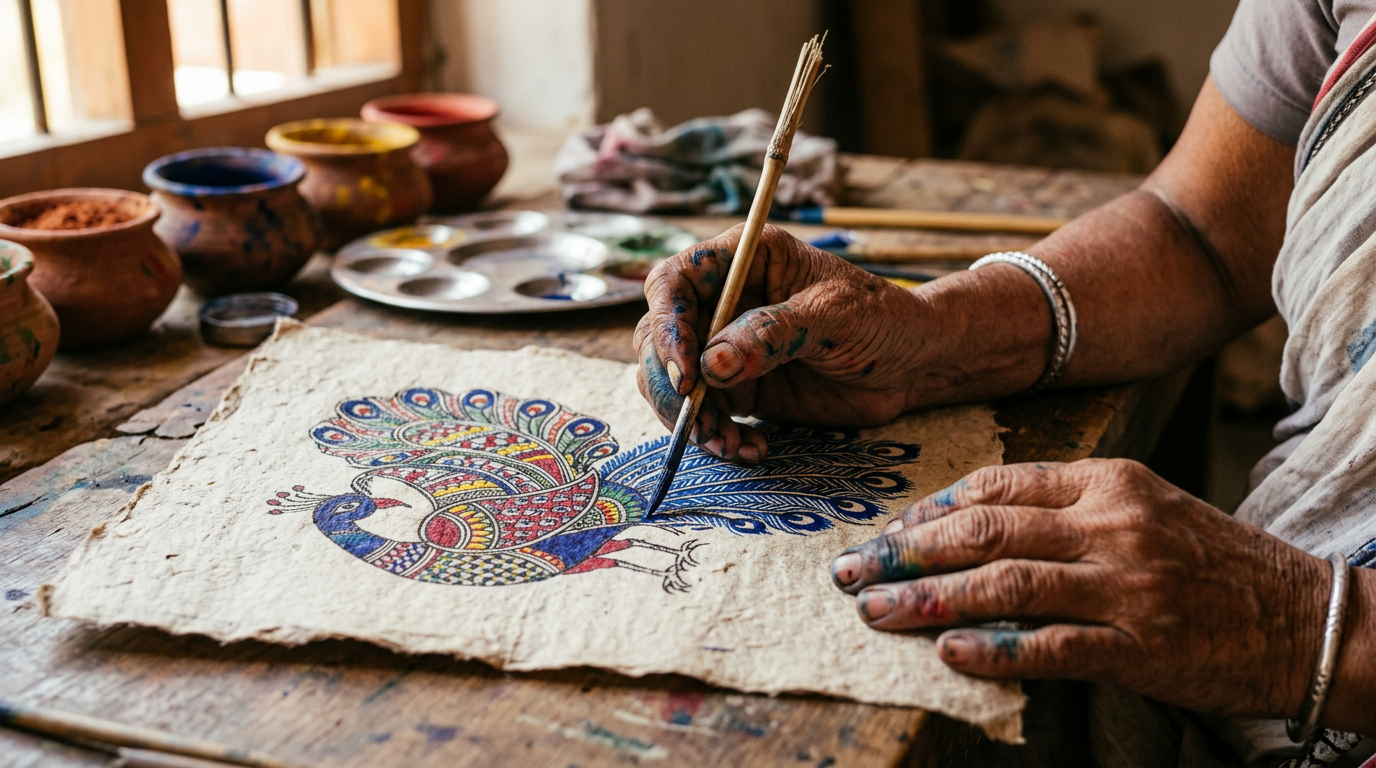
Before an algorithm can learn, we must first understand what it is learning. Madhubani art, also known as Mithila painting, is not merely decorative. It is a living, breathing form of social and spiritual storytelling, traditionally practiced by the women of the Mithila region in Bihar, India. Born from the earth itself, its history is a of faith, community, and profound artistic expression.
A Legacy Painted on Walls and Paper
Legend traces its origins to the court of King Janaka, who commissioned artists to capture the wedding of his daughter, Sita, to Lord Rama. For centuries, these paintings adorned the mud walls and floors of homes, created during festivals and ceremonies. The art is characterized by its complex geometric patterns, vibrant natural colors, and a distinct lack of empty space, a style known as “horror vacui.”
The Five Distinct Styles
The tradition is not monolithic; it encompasses several unique styles, each with its own rules and thematic focus. Understanding these is critical for any preservation effort, digital or otherwise.
- Bharni: Meaning “filling,” this style uses bright, vivid colors to depict Hindu deities and epic narratives.
- Katchni: Characterized by intricate line work and hatching, typically using only one or two colors.
- Tantrik: Explores religious texts and spiritual symbolism, often featuring deities like Kali and Durga.
- Godna: A simpler, tattoo-like style using concentric circles and parallel lines.
- Kohbar: Specifically created for the nuptial chamber, filled with symbols of prosperity, fertility, and love.
The Looming Threat of a Fading Art
Despite its rich history, Madhubani has faced a slow decline. Younger generations, drawn to urban opportunities, often lack the patience for the painstaking apprenticeship required. Mass-produced prints dilute the market, making it difficult for true artisans to earn a sustainable living. The hands that paint grow fewer, and with them, the risk of losing this invaluable cultural language forever.
TECHNOLOGICAL INTERVENTION
The Ghost in the Machine: Can AI Understand Art?
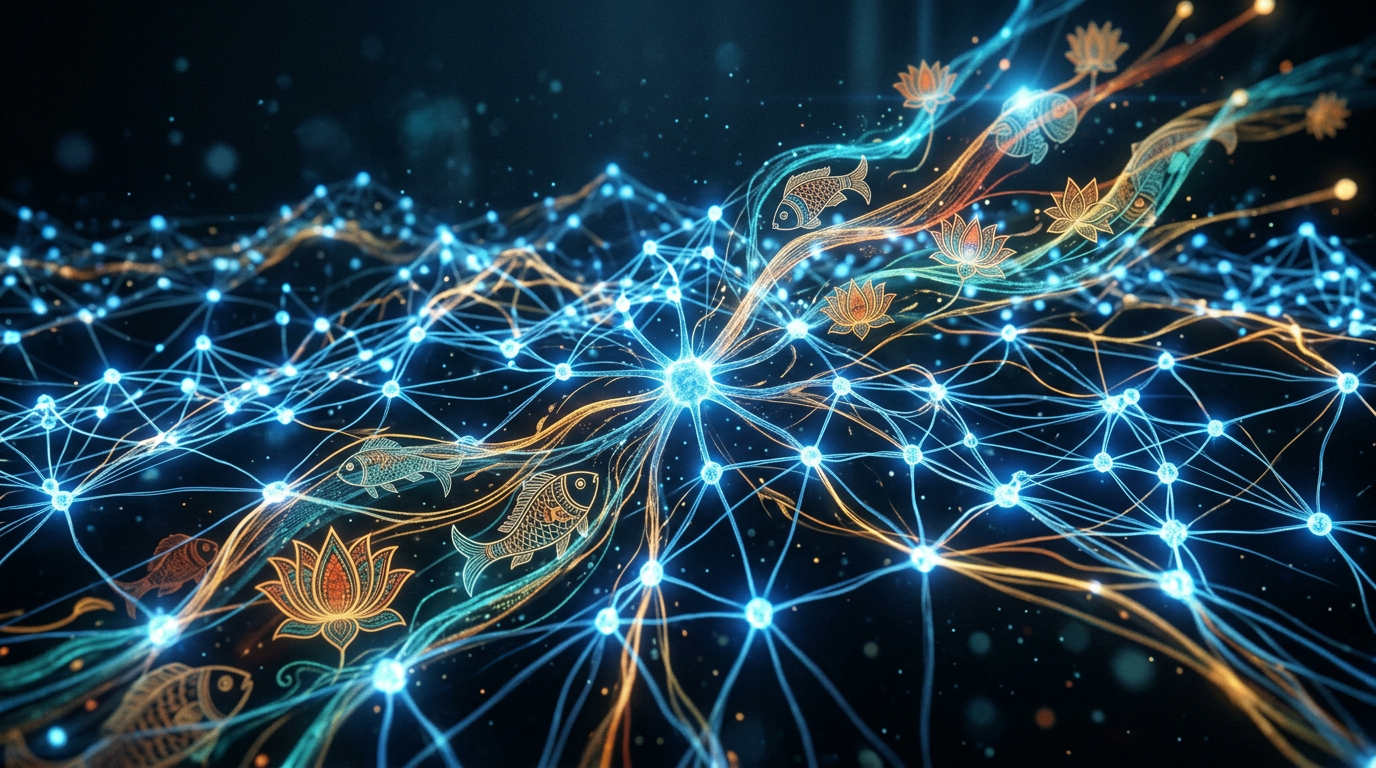
Enter Dr. Aryan Sharma and his “Project Mithila,” an ambitious initiative to apply AI to cultural preservation. The central question was daunting: could an AI, trained on data and logic, learn the nuances of an art form steeped in devotion? The project wasn’t about replacing the artist but about creating a new kind of tool—a digital archivist, a tireless apprentice, and an inspirational collaborator.
From Code to Canvas: The AI’s Role
The technology at the heart of this project is a class of AI known as Generative Adversarial Networks (GANs). In simple terms, a GAN consists of two competing neural networks:
- The Generator: This network tries to create new images that mimic the style of the art it has been trained on (in this case, thousands of Madhubani paintings).
- The Discriminator: This network acts as a critic, trying to distinguish between the real, human-made art and the AI-generated fakes.
Through this constant competition, the Generator becomes incredibly adept at creating new, authentic-looking Madhubani-inspired designs. It learns the rules of composition, the color palettes, and the symbolic language of the art form.
The Preservation Imperative
Before creation comes preservation. The first, and perhaps most critical, task for the AI was to serve as a digital archivist. By creating ultra-high-resolution scans of existing artworks, especially older, fading pieces, the project built a comprehensive database. As highlighted in the State of AI Report 2025, AI’s capability in data analysis and pattern recognition is growing exponentially, making it the perfect tool for documenting and categorizing vast cultural datasets.
CASE STUDY
A Digital Renaissance: The Madhubani Painting AI Collaboration
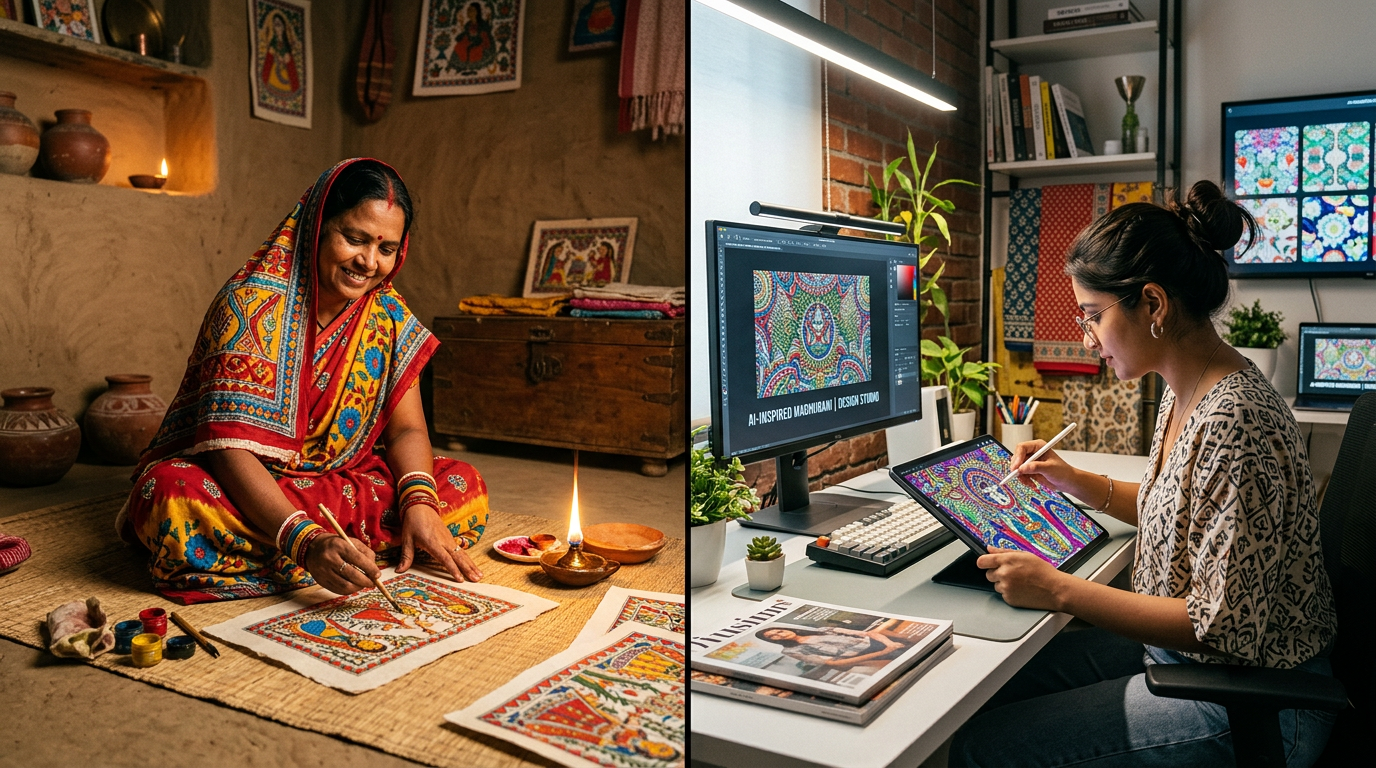
The true breakthrough came not from a lab in Bangalore, but from the dusty courtyards of Mithila. The project’s success hinged on a deep, respectful collaboration between technologists like Dr. Sharma and master artisans like Anjali and her grandmother, Radha. It was a journey from skepticism—”A machine has no soul!”—to a powerful .
The AI as an Apprentice, Not a Master
The initial AI-generated images were technically precise but spiritually hollow. They had the patterns but lacked the jeevanta—the life force—that a human hand imparts. This “failure” was a pivotal moment. The team shifted their focus: the AI would not be the artist. Instead, it would become the ultimate assistant. This reframing from replacement to augmentation was the key to earning the artists’ trust.
Documenting the Intangible
The collaboration went beyond just scanning images. The AI was trained on a richer dataset that attempted to capture the art’s soul:
- Pigment Analysis: The chemical composition of natural dyes like lampblack, ochre, and indigo was documented, allowing the AI to suggest historically accurate color palettes.
- Brushstroke Emulation: High-speed cameras recorded the unique application techniques—the use of twigs, fingers, and nib-pens—to understand the “imperfections” that make the art perfect.
- Thematic Tagging: Each motif (fish for fertility, peacock for love, lotus for purity) was tagged with its cultural significance, teaching the AI the narrative language of Madhubani.
What the AI Learned from the Artisans
| Learning Domain | What Was Captured | How It’s Used |
|---|---|---|
| Structural Grammar | Unwritten rules of filling space and creating borders | Generates compositions that feel authentic |
| Symbolic Vocabulary | The meaning behind every fish, bird, and deity | Ensures cultural accuracy in generated motifs |
| Stylistic Signatures | Subtle differences between Bharni, Katchni, and other styles | Style-specific generation and classification |
| Generational Drift | How motifs and techniques have evolved over time | Documents the evolution for future scholars |
METHODOLOGY
The Process Unveiled: How AI Assists, Not Replaces
So how does this partnership work in practice? The Madhubani Painting AI workflow is a three-step process designed to the artist, streamline production, and open new creative frontiers—all while keeping the human hand at the center of every creation.
Step 1: Digital Archiving and Pattern Recognition
The AI begins by ingesting thousands of high-resolution scans of traditional Madhubani paintings. Using convolutional neural networks (CNNs), it identifies recurring patterns, motifs, and compositional rules. This creates a living digital archive—a searchable library of the art form’s entire visual vocabulary. For the artisans, this means instant access to motifs from centuries-old works that might otherwise be lost to time and decay.
Step 2: AI-Assisted Design and Inspiration
Armed with this deep understanding, the AI can generate new compositions that respect the traditional grammar. An artist might say, “Create a Kohbar-style border with fish and lotus motifs,” and the AI produces multiple options as a starting point. The artist then selects, modifies, and refines—bringing their irreplaceable human creativity and spiritual intention to the final piece.
Step 3: Market Access and Economic ment
Perhaps the most transformative application is economic. AI-powered platforms can connect artisans directly to global markets, bypassing exploitative middlemen. The technology enables:
- Authentication: AI verifies the authenticity and style of a painting, protecting buyers and legitimate artists from forgeries and mass-produced imitations.
- Custom Design Tools: Customers can specify themes and styles, and the AI generates a preview that the artisan then hand-paints, merging personalization with tradition.
- Dynamic Pricing: Machine learning models can suggest fair pricing based on complexity, size, style, and market demand, ensuring artisans receive fair compensation.
THE LIVING FUTURE
Preserving the Soul While Embracing the Machine
The story of Madhubani Painting AI is ultimately a story about balance. It is proof that technology, when wielded with respect and cultural sensitivity, can be a force for profound good. The AI is not replacing the grandmother teaching her granddaughter the meaning of the lotus. It is ensuring that this teaching, and the art that flows from it, endures for centuries to come.
The most powerful technology is not the one that replaces human creativity, but the one that amplifies it. In the villages of Mithila, an ancient art form is not just surviving—it is being reborn, its colors brighter and its reach wider than ever before, painted by human hands guided by digital minds.
Impact at a Glance
| Dimension | Before AI | With AI Partnership |
|---|---|---|
| Preservation | Fading artworks lost to decay | Ultra-high-res digital archive of thousands of works |
| Market Access | Local sales, middleman exploitation | Global e-commerce with authentication |
| Training | Years-long apprenticeship, few students | AI-assisted learning tools alongside masters |
| Innovation | Tradition slowly stagnating | New fusion styles while respecting roots |
Published by Adiyogi Arts. Explore more at adiyogiarts.com/blog.
Written by

Aditya Gupta
Responses (0)